


Hey space and tech fans! The battle for the ultimate off-world internet connection just hit a massive new milestone. For a while now, laser-based optical communication has been the holy grail for satellite internet, and this week, the competition between Europe and China reached literally astronomical heights.
Let’s break down the insane speeds and distances these space agencies are achieving with pure laser beams!
🚀 Europe’s ESA Hits a Blistering 2.6 Gbps

The European Space Agency (ESA), teaming up with Airbus, just shattered a major speed barrier. They successfully locked a laser terminal onto the Alphasat TDP 1 satellite, which is casually sitting in Geostationary Earth Orbit (GEO) about 36,000 kilometers above our heads.
Here is the breakdown of the ESA test:
- Speed: 2.6 Gigabits per second (Gbps).
- Stability: Maintained a flawless connection for several minutes with zero data packet loss.
- Real-World Impact: This speed can transfer a high-definition feature film in seconds instead of minutes.
Shooting a laser across 36,000 km and hitting a moving target without atmospheric turbulence or platform vibrations ruining the signal is incredibly difficult. This breakthrough means that “digital dead zones” for long-haul flights, deep-ocean research vessels, and remote desert vehicles could soon be a thing of the past.
🇨🇳 China’s Long-Distance Marathon Connection

Just days after Europe’s announcement, China stepped up to the plate with its own jaw-dropping achievement. The Chinese Institute of Optoelectronics revealed they established a laser link that prioritized distance and endurance over raw speed.
- Distance: 40,000 kilometers.
- Speed: 1 Gbps.
- Endurance: The connection held strong for a massive three hours.
Using a 1.8-meter ground station equipped with high-order adaptive optics, the Chinese team managed to correct atmospheric signal distortions in real-time. Even more impressively, it took the system only four seconds to lock onto the satellite!
🛰️ The Low Earth Orbit (LEO) Battlefield
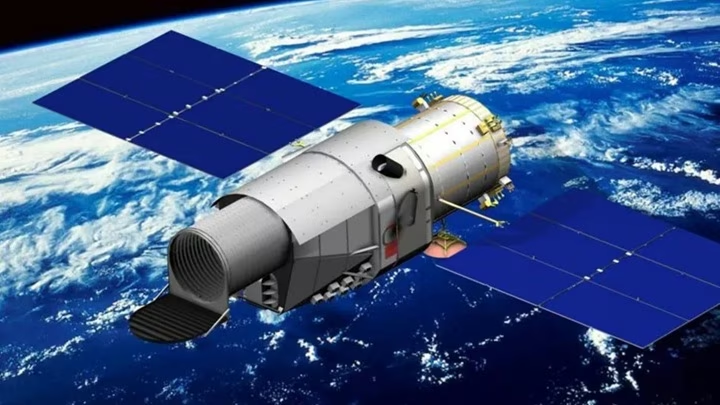
While GEO satellites are breaking distance records, the real speed wars are happening closer to home in Low Earth Orbit (LEO):
- China’s LEO Record: Back in January, China announced a mind-bending 120 Gbps laser connection speed in LEO, doubling their previous record.
- SpaceX Entering the Chat: SpaceX is currently gearing up to deploy its third-generation Starlink satellites. These next-gen units are expected to deliver terabit-per-second download capacities and over 200 Gbps upload speeds.
If this tech keeps evolving at this pace, ultra-fast, seamless internet won’t just cover the most remote corners of Earth—it will power our future missions to the Moon and beyond.