
Crypto exchange Coinbase Global has launched a mortgage structure with Better Home & Finance that lets qualified borrowers pledge digital assets held in Coinbase accounts to fund down payments on standard conforming mortgages designed in accordance with Fannie Mae guidelines.
According to Coinbase, the structure enables borrowers to pledge digital assets such as Bitcoin (BTC) or USDC (USDC) as collateral for a separate loan used to fund the down payment, while the primary mortgage remains a standard, Fannie Mae–backed loan. Better will originate and service the mortgages.
When rolled out, the new development could mark a shift in how crypto assets are used in US housing finance, extending their role from qualifying assets in underwriting to a more direct component of mortgage financing.
The news follows earlier regulatory signals to integrate crypto into mortgage frameworks. In June, the US Federal Housing Finance Agency directed Fannie Mae and Freddie Mac to prepare proposals to recognize cryptocurrency as an asset in mortgage risk assessments without requiring conversion to US dollars.
It also builds on a series of developments integrating crypto into home lending, with lenders like Newrez and Rate recently recognizing crypto holdings in underwriting, signaling a broader push to embed crypto across the mortgage stack.
Cointelegraph reached out to Fannie Mae for more information but did not receive a response before publication.
Pledging crypto for down payments comes with added risks
According to Coinbase, borrowers would take out a standard conforming mortgage while using a separate loan secured by crypto holdings to cover the down payment.
The setup allows buyers to retain exposure to digital assets, but replaces upfront cash with additional debt.
Related: Crypto mortgages in US face valuation risks, regulatory uncertainty
Coinbase said the model introduces constraints tied to pledged assets, with borrowers unable to trade collateral while it is locked.
The company said market volatility alone does not trigger margin calls as long as borrowers continue making payments, and mortgage terms remain unchanged once the loan is active.
The model also introduces new risks tied to the pledged assets. While price swings do not directly affect the mortgage, they may still influence borrower risk exposure and financial decisions over time.
Lenders have been gradually integrating crypto into mortgage underwriting
The new development follows several US lenders that recently incorporated crypto assets into mortgage processes.
On Jan. 17, loan servicer Newrez said it would allow borrowers to use BTC, Ether (ETH), crypto ETFs and stablecoins as qualifying assets in underwriting, without requiring liquidation.
On Feb. 23, mortgage lender Rate launched its RateFi program, which allows verified crypto holdings to count toward reserves and, in some cases, income. However, borrowers are still required to convert their crypto into cash for down payments and closing costs.
Ex-Congressman Ryan frames crypto as a housing tool
Ahead of the rollout, Cointelegraph’s Turner Wright spoke with former Ohio Representative Tim Ryan, a member of Coinbase’s advisory council who has focused on middle-class affordability, including housing.
Ryan cast mortgage financing as a practical, real-world use case for crypto, arguing that digital assets can unlock wealth for early investors and help address one of the biggest barriers to homeownership — the down payment.
“Digital assets have a place for working-class people… all the way down to getting a home,” Ryan said. “To see the industry move into… the housing sector… is a really huge deal.”
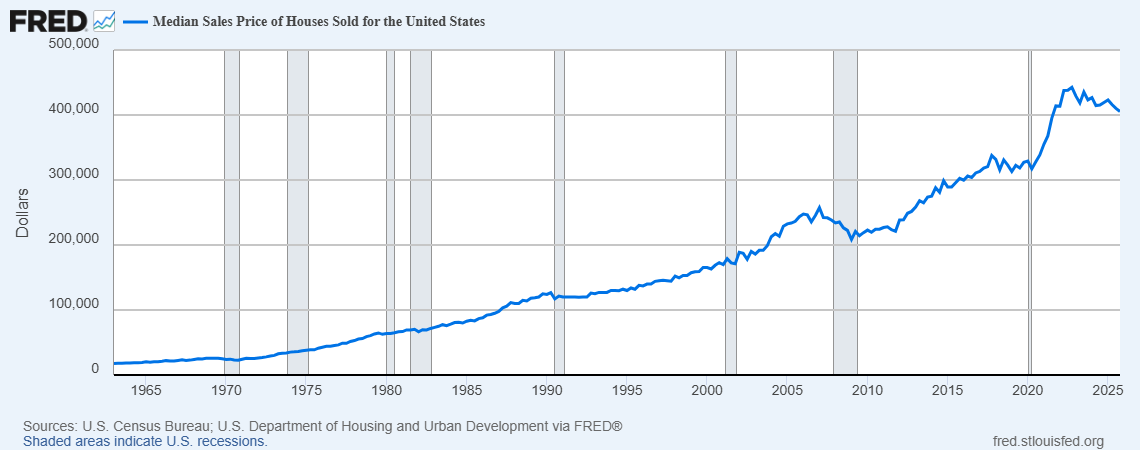
Affordability remains a major challenge for US homebuyers. Despite slower activity tied to low inventory and elevated mortgage rates, the average home price still exceeded $405,000 in the fourth quarter.

A 20% down payment, often required to avoid private mortgage insurance, would still cost buyers more than $80,000, a hurdle that could be less challenging now for crypto investors.
Additional reporting by Sam Bourgi and Turner Wright.
Related: Bitcoin ‘compression’ outcome may send BTC to $80K: Analyst
Magazine: Nobody knows if quantum secure cryptography will even work