


I honestly had to read the news headline twice this morning. While I’m used to covering the latest AI breakthroughs and hardware updates here at Metaverse Planet, a story about a robot getting “arrested” by local police genuinely caught me off guard.
We’ve all seen the polished promotional videos of humanoid robots doing backflips or neatly folding laundry. But what happens when you take these machines out of the controlled environment of a laboratory and drop them onto a busy sidewalk on a Tuesday night?
Well, as an incident in Macau recently proved, things can get incredibly awkward, a little bit terrifying, and legally very complicated. Let’s dive into what happened with the “arrested” robot, why it matters, and what this means for the future of human-robot interaction.
The Incident in Macau: What Exactly Happened?

The event took place in the Macau Special Administrative Region of China, near a residential complex around 9:00 PM. A 70-year-old woman was walking down the street, looking at her phone, minding her own business. When she suddenly stopped, she realized she wasn’t alone.
Looming silently right behind her was a humanoid robot.
According to eyewitnesses and footage that quickly flooded social media, the elderly woman was absolutely terrified. And honestly, I can’t blame her. If I turned around in the dark to find a faceless metal humanoid standing inches away from me, my heart rate would spike too. In the videos, you can clearly hear the panicked woman scolding the machine, shouting, “You’re going to make my heart jump out of my chest!”
A 70-Year-Old Woman vs. The Unitree G1
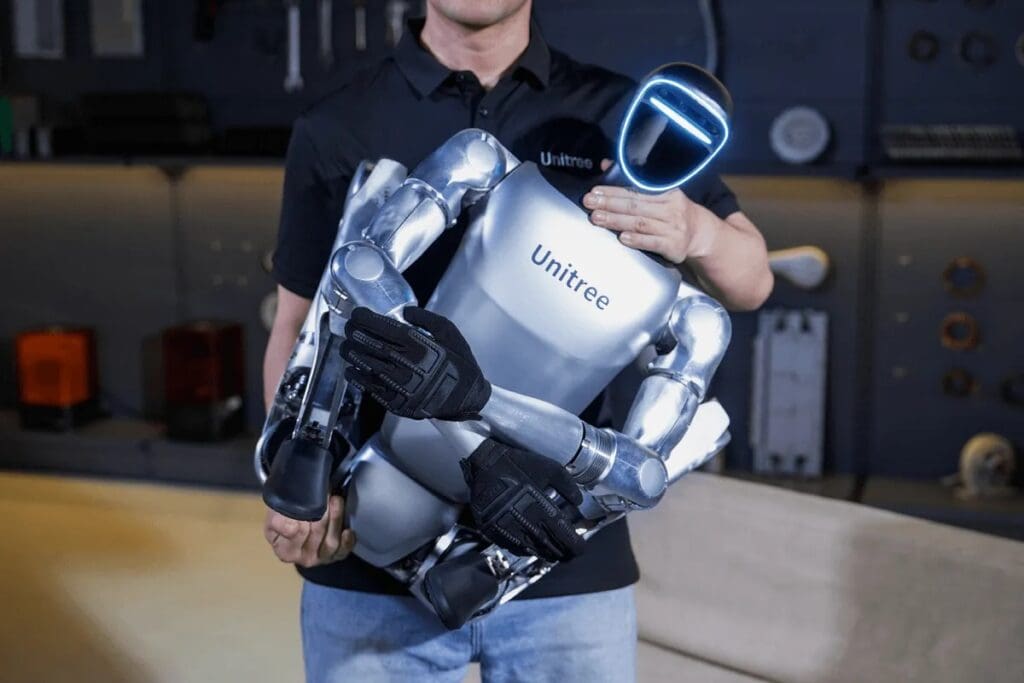
The robot in question was identified as the G1 model, developed by the prominent Chinese robotics company Unitree.
So, what was a high-tech humanoid doing creeping up on pedestrians? According to local police, the robot belonged to a nearby educational center and was being used outside for promotional purposes.
The issue wasn’t malicious intent; it was a pathfinding failure. When the elderly woman suddenly stopped on the sidewalk, the robot’s navigation system couldn’t figure out how to maneuver around her. Instead of recalculating a wider path or turning around, it simply defaulted to standing completely still, silently waiting directly behind her.
Why Did the Police Intervene?

Because the woman was so distressed, emergency services were called to the scene. She felt unwell from the sheer shock of the encounter and had to be taken to the hospital for medical evaluation. Thankfully, she was discharged shortly after and decided not to file a formal complaint against the robot’s operator.
However, the police still had to act. They “detained” the robot—removing it from the street—and tracked down its human owner.
Because we currently lack a defined legal framework for “robot crimes” (a sentence I never thought I’d write), the police simply issued a stern warning to the owner, urging them to operate their hardware more responsibly in public spaces, and handed the machine back.
The Real Issue: AI Lacks “Social Etiquette”

When I research these robotics companies, I see incredibly advanced spatial mapping, LiDAR integration, and dynamic balancing. But this incident highlights a massive blind spot in current robotics: social etiquette.
- The Navigation Dilemma: A robot might know how to walk, but it doesn’t understand how to behave around humans.
- The Creep Factor: Standing completely silent, two inches behind a stranger at night, might be the most mathematically efficient way to wait for an obstacle to clear, but socially, it is terrifying.
- Contextual Awareness: Humans instinctively leave personal space. We clear our throats, step aside, or make noise to announce our presence. The Unitree G1 lacked this basic human context.
The Legal Gray Area: Who is Responsible?
This seemingly minor event in Macau opens up a Pandora’s box of legal questions that lawmakers are completely unprepared for.
If a robot physically harms someone, we generally assume the manufacturer or operator is at fault. But what about psychological distress?
- If a robot’s navigation algorithm causes an elderly person to suffer a heart attack from shock, is it manslaughter?
- Do we blame the operator holding the remote, or the software engineer who wrote the pathfinding code?
Right now, the authorities treated this like a poorly behaved pet. The owner got a warning. But as these machines scale in size and autonomy, “giving a warning” simply won’t cut it.
China’s Role as the Global Beta-Testing Ground
It’s no coincidence that this happened in China. The country is pushing the boundaries of commercial robotics faster than almost anyone else. In some Chinese cities, it’s becoming increasingly common to see humanoid robots assisting with traffic control or patrolling streets.
But treating public sidewalks as beta-testing environments comes with inherent risks. When you mix highly complex, unpredictable human behavior with rigid, unpolished AI navigation, you are bound to get friction.
I’ve always believed that the hardware is the easy part. Building motors and joints that mimic human movement is a solvable physics problem. Teaching a machine the nuanced, unspoken rules of human society? That’s going to be much, much harder.
My Takeaway: The Uncanny Valley in the Real World
I find this whole situation both fascinating and slightly alarming. It’s a perfect example of technology moving faster than society.
The Macau incident is historically significant. It might be remembered as one of the first times law enforcement had to physically intervene between a humanoid robot and a civilian in a non-industrial setting. It wasn’t a Terminator-style uprising; it was just a confused machine with bad manners. But the human fear it generated was 100% real.
As we move forward, companies like Unitree, Tesla, and Boston Dynamics need to realize that they aren’t just building tools; they are building entities that will share our physical space. If they don’t program these machines with a deep understanding of human psychology and comfort zones, public backlash is inevitable.
What do you think? If you were walking alone at night and turned around to find a humanoid robot silently staring at you, how would you react? And more importantly, who do you think should be held legally responsible if someone actually gets hurt in a situation like this? Let’s discuss it in the comments.