


I was casually scrolling through my feed the other day when a video stopped me dead in my tracks. I was completely mind-blown when I saw Toyota’s new CUE7 basketball robot in action. We’ve all seen tech demos before—robots doing backflips or serving coffee—but this felt entirely different. Out there on the hardwood, this machine wasn’t just existing; it was dominating. It dribbles, it shoots, and it moves with a terrifying, calculated accuracy that honestly gave me goosebumps.
I’ve been writing about the metaverse and AI for a while now, and I usually look at software, algorithms, or virtual worlds. But seeing artificial intelligence manifest in a physical, competitive space completely shifted my perspective. This isn’t just a clunky machine programmed for a parlor trick; it’s a glimpse into a future where the lines between human athleticism and machine precision are entirely blurred.
Let’s dive deep into what Toyota is doing with the CUE7, how this tech actually works, and why watching a machine play with absolutely zero fatigue is making me question everything I thought I knew about the future of sports.
From Humble Beginnings to Hardwood Dominance
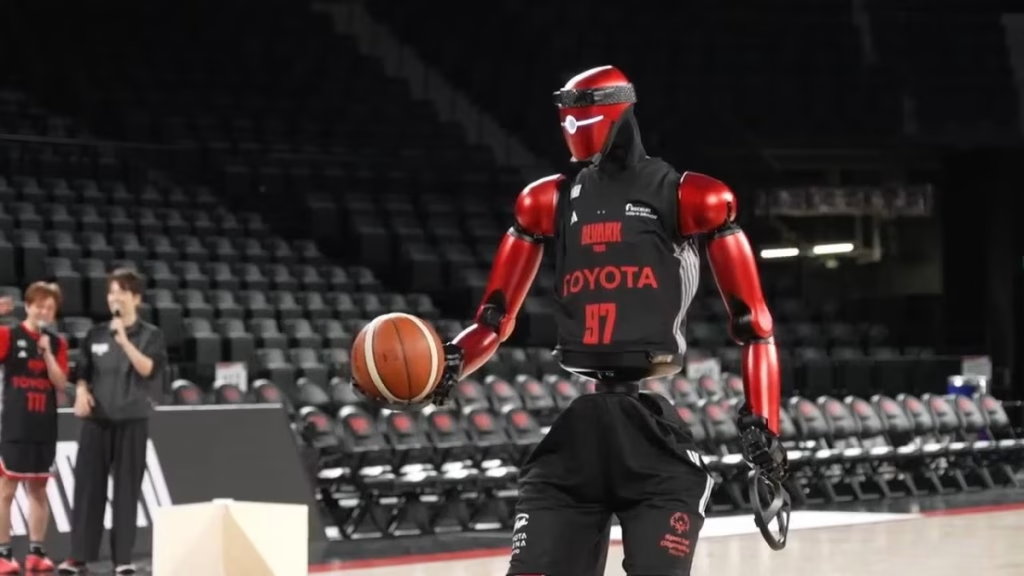
When I started digging into the history of Toyota’s CUE project, I was genuinely surprised by how fast this technology has evolved. The original CUE robot was a fun side project by Toyota volunteers, basically a stationary shooting machine. But the CUE7? It’s a completely different beast.
Here is what makes the CUE7 stand out from anything we’ve seen before:
- Fluid Mobility: Unlike its predecessors that had to be wheeled into place, the CUE7 actually moves around the court. It calculates its positioning in real-time, adjusting its stance based on where it needs to be.
- Dynamic Dribbling: This is the part that genuinely spooked me. Dribbling a basketball requires an understanding of physics, bounce trajectory, and spatial awareness. The CUE7 processes all of this instantaneously, keeping the ball in motion without missing a beat.
- Pinpoint Shooting Accuracy: By using advanced sensors and an internal AI that calculates the exact distance, arc, and force needed to sink a basket, the CUE7 achieves a shooting percentage that would make NBA legends jealous.
The Secret Sauce: How AI is Changing the Game
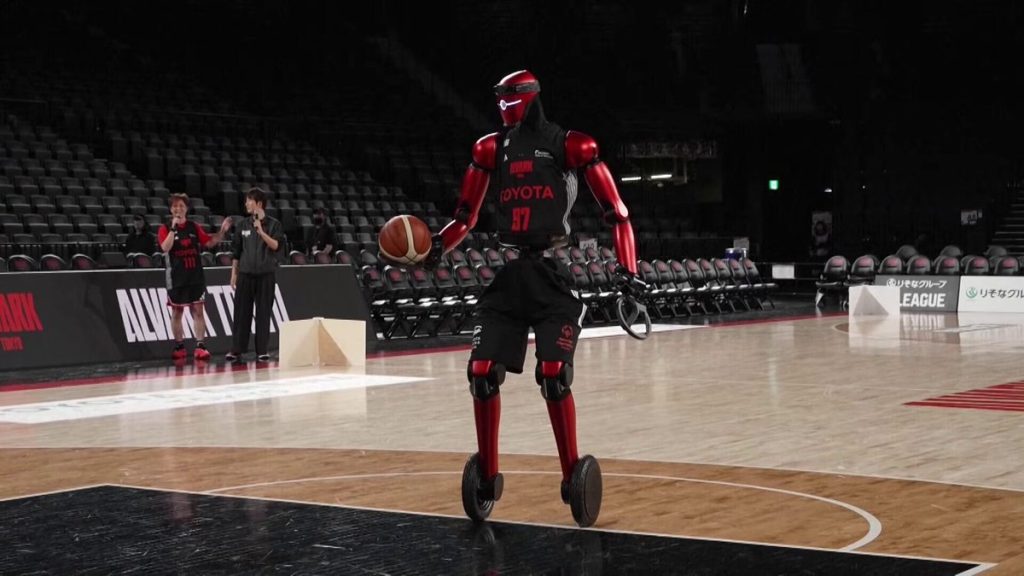
To me, the most fascinating aspect of the CUE7 isn’t its mechanical arms or its metal frame; it’s the invisible “brain” powering it all.
When a human player takes a shot, they rely on muscle memory, instinct, and a split-second visual assessment of the hoop. The CUE7 replaces human instinct with complex algorithms and spatial computing. It uses cameras and depth sensors on its torso to build a 3D map of the court. In a fraction of a second, the AI computes the distance to the basket, the current air resistance, and the optimal parabolic trajectory required for a swish.
But here is the real kicker: Machine Learning. The robot isn’t just executing pre-written code. It learns from every single shot. If it misses (which is rare), the AI analyzes the physical data of that failure and adjusts its micro-movements for the next attempt. I realized that we are watching an entity that literally perfects itself in real-time.
The Unfair Advantage: The Reality of Zero Fatigue
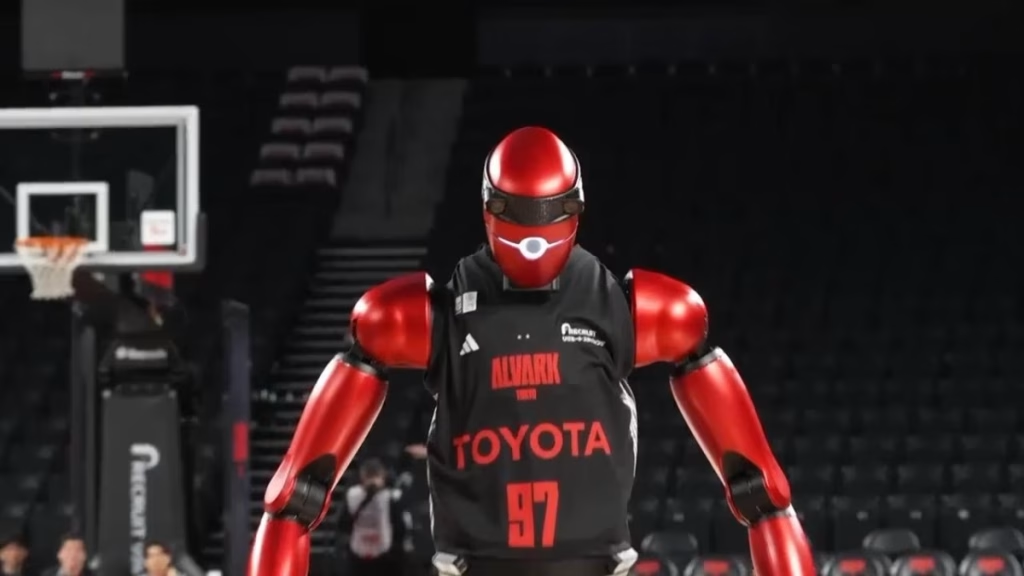
Let’s talk about the physical toll of sports. Basketball is an exhausting game. By the fourth quarter, legs get heavy, breathing gets shallow, and shooting percentages naturally drop. It’s part of the human condition.
Watching the CUE7, the realization hit me hard: this machine feels absolutely nothing. It doesn’t get tired. It doesn’t get intimidated by a loud crowd. It doesn’t suffer from performance anxiety during a clutch moment. It will shoot its 1,000th shot with the exact same precision, power, and arc as its very first shot. This “zero fatigue” factor is what makes me question the future of human dominance in sports.
If we eventually pit human athletes against AI-driven machines, how can flesh and bone ever compete against an opponent that never tires and calculates physics down to the millimeter?
Beyond Basketball: Why This Matters for Our Future
You might be thinking, “Ugu, it’s just a robot playing basketball, why the big deal?” I thought the same thing initially, but the implications go way beyond the court. The CUE7 is essentially a masterclass in robotic spatial awareness and delicate physical interaction.
If an AI can be trained to dynamically dribble a bouncy ball and shoot it perfectly into a small ring from 20 feet away, that exact same technology can be applied to:
- Advanced Prosthetics: Creating artificial limbs that react to their environment with fluid, natural precision.
- Search and Rescue: Developing agile robots that can navigate unpredictable, physically demanding disaster zones.
- Everyday Assistance: Building humanoid helpers that can interact with fragile objects in our homes without breaking them.
The basketball court is just Toyota’s testing ground. The real goal is teaching AI how to flawlessly interact with the physical physics of our world.
The Final Whistle: Are We Ready?
I’ve spent hours analyzing the footage, looking at the specs, and thinking about the trajectory of this technology. There is a part of me that is incredibly excited to see how AI will push human athletes to train harder and smarter. But there’s another part of me that feels a strange sense of nostalgia for the beautiful imperfection of human sports.
The sweat, the fatigue, the miraculous buzzer-beaters that defy all logic—that’s the soul of the game. A machine like the CUE7 might be able to replicate the mechanics of basketball perfectly, but can it ever replicate the heart?
This brings me to a massive crossroads, and I really want to know where you stand on this. I’ve laid out my thoughts, but this is a conversation we need to have together.
Will AI eventually rule the courts, completely replacing the thrill of human athleticism, or will robots like the CUE7 just remain highly advanced training tools for us? Drop a comment below and pick a side. I’ll be hanging out in the replies!