
Recurring Orders vs Concentrated Liquidity
Recurring Orders and Concentrated Liquidity are two popular onchain trading strategies that may initially appear similar. On the surface, both involve buying and selling as price moves within a range.
In practice, however, these two strategies behave very differently inside the price range, generate returns through different approaches, and express different types of trading intent.
This comparison is not technical and is not about which strategy is “better.” Instead, it focuses on how each strategy behaves and the contexts in which each approach may be most effective.
For the more technical explanation of Concentrated Liquidity and Recurring Orders, see ‘Concentrated Liquidity and Recurring Orders: Two Execution Architectures’ and the Carbon DeFi whitepaper for the more technical explanation regarding the bonding curves powering Recurring Orders.
How they behave inside price ranges
Concentrated Liquidity
Funds are generally placed at and around the current market price within a single defined price range.
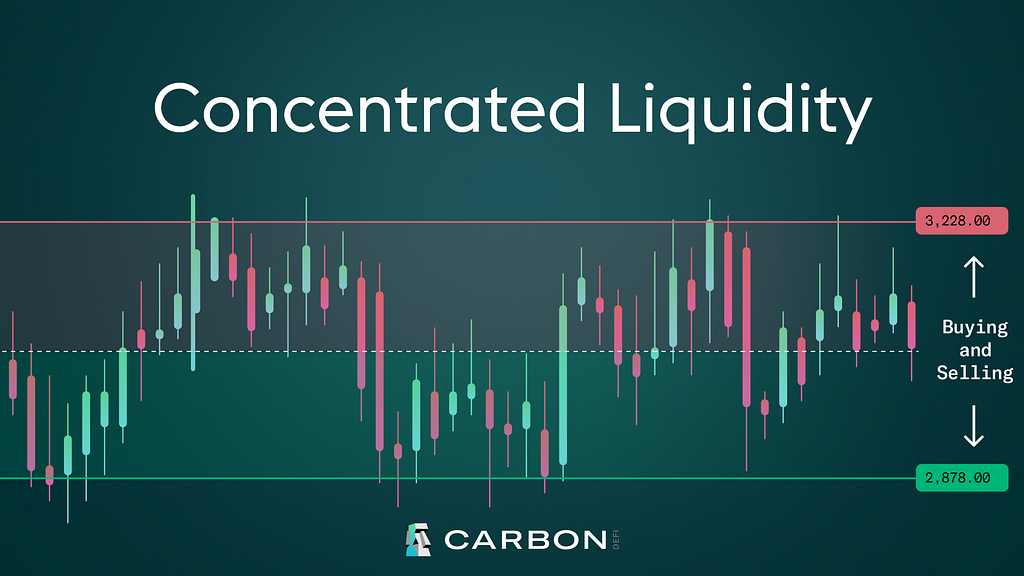
As price moves through that range, ideally the position is buying and selling continuously. In practice, this means a maker is buying back where they just sold, and selling where they just bought — plus or minus some sort of delta to induce a spread.
The behavior is symmetric and reactive, recycling funds inside the same range as price fluctuates.
Recurring Orders
Recurring Orders do not overlap in the same way Concentrated Liquidity positions do, and therefore do not buy and sell within a single range. Instead, they separate buying and selling into two distinct price ranges.
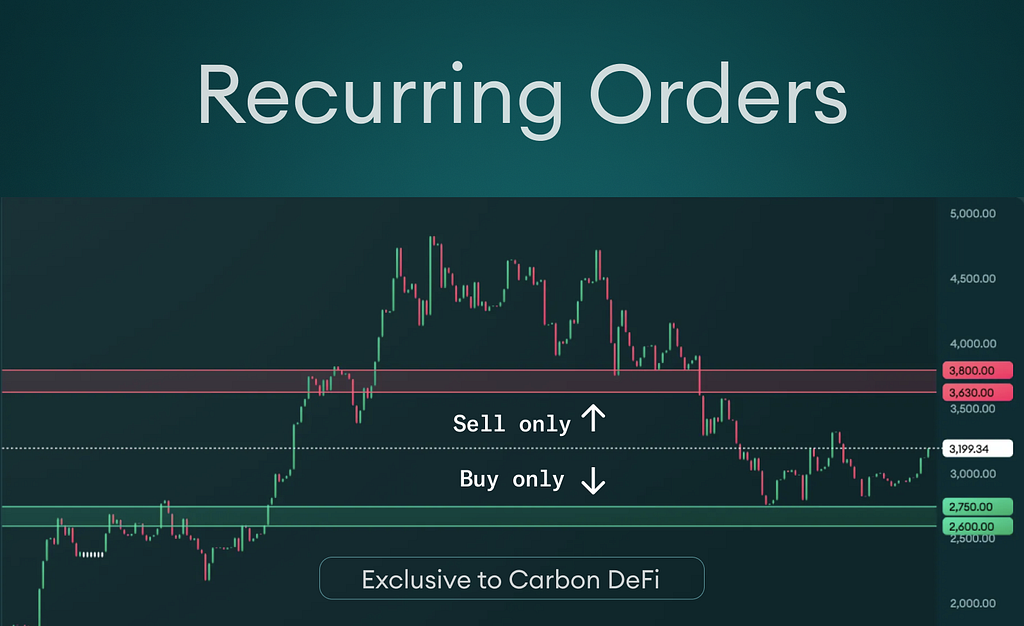
Buys occur only within the buy range.
Sells occur only within the sell range.
The behavior is asymmetric and intentional. Funds are recycled from one range to the other, expressing a clear buy low/sell high intent.
Market positioning and strategy success
Concentrated Liquidity
The objective is to provide liquidity for traders to trade against.
Success depends more on how much time is spent inside a narrow band, and less on predicting where price will move next.
Because of this, liquidity is typically positioned at or around the current market price.
Concentrated Liquidity tends to perform best when Token A and Token B:
- Consistently trade within a narrow band
- Are pegged to each other, such as ETH and wETH
- Are pegged to a local currency, such as USDT and USDC
Recurring Orders
The objective is to consistently buy low and sell high, not to capture ongoing trading activity.
Instead of positioning liquidity around the current market price, buy and sell ranges are deliberately placed above and below it. Trades only take place when price reaches those predefined levels.
Because of this, success depends less on the current price and more on how price moves between the defined buy and sell ranges over time.
Recurring Orders are generally best suited for:
- Volatile markets with meaningful price swings
- Systematic accumulation or distribution strategies
- Traders who want to express directional intent without manually timing entries and exits
- Creating a custom marketplace
It’s important to note one important difference:
- Concentrated Liquidity requires providing both tokens in the pair.
- Recurring Orders allow users to choose whether to provide one token or both.
https://medium.com/media/8dde5ff6d023108845e81773d2f69372/href
Where backtesting becomes essential
The Carbon DeFi Simulator allows users to explore both approaches using historical market data and observe how each strategy would have behaved.
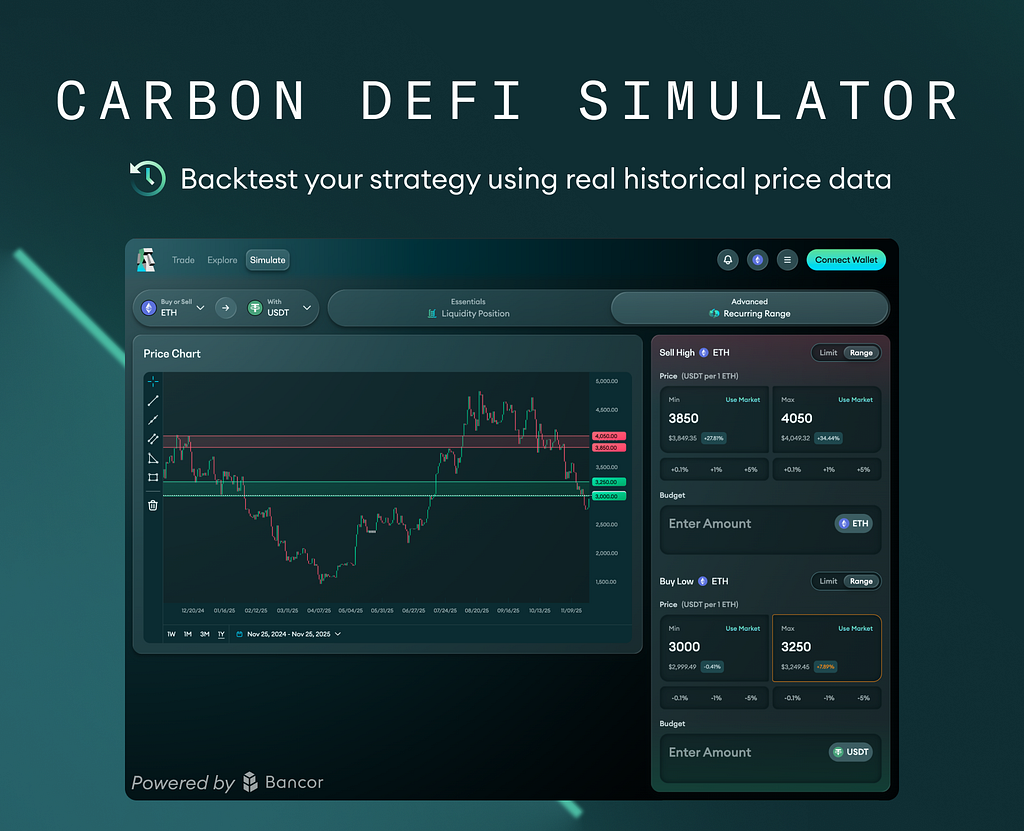
Using the Simulator, it is possible to:
- Observe how each strategy behaves across the same historical price movements
- Compare Recurring Orders and Concentrated Liquidity side by side under identical market conditions
- Adjust ranges and spreads to see how small changes affect strategy behavior and outcomes
- Visualize trade execution and capital movement over time, rather than relying on point-in-time snapshots
- Develop intuition for how strategies respond to volatility, trends, and ranging markets
Both strategy types are adjustable onchain, allowing users to apply what they learn from the Simulator to refine live strategies without withdrawing liquidity or recreating positions.
Predicting the future is nearly impossible but users can gain an understanding of how different strategies behave under real market conditions — and use that understanding to make more informed decisions.
Explore both strategies using the Carbon DeFi Simulator.
Bancor
Bancor is a pioneer in decentralized finance (DeFi), established in 2016. It invented the core technologies underpinning the majority of today’s automated market makers (AMMs) and continues to develop the foundational infrastructure critical to DeFi’s success — focusing on enhanced liquidity mechanics and robust onchain market operation. All products of Bancor are governed by the Bancor DAO.
Website | Blog | X/Twitter | Analytics | YouTube | Governance
Carbon DeFi
Carbon DeFi, Bancor’s flagship DEX, enables users to do everything possible on a traditional AMM — and more. This includes custom onchain limit and range orders, with the ability to combine orders into automated buy low, sell high strategies. It is powered by Bancor’s latest patented technologies: Asymmetric Liquidity and Adjustable Bonding Curves.
Website | X/Twitter | Analytics | Telegram
The Arb Fast Lane
DeFi’s most advanced arbitrage infrastructure powered by Marginal Price Optimization, a new method of optimal routing with unmatched computational efficiency.
Website | Research | Analytics
Two Similar Trading Strategies — Two Completely Different Outcomes was originally published in Bancor on Medium, where people are continuing the conversation by highlighting and responding to this story.